From Crisis to Crisis: Why Europe Must Stop Subsidising Fossil Fuels and Start Building Energy Sovereignty
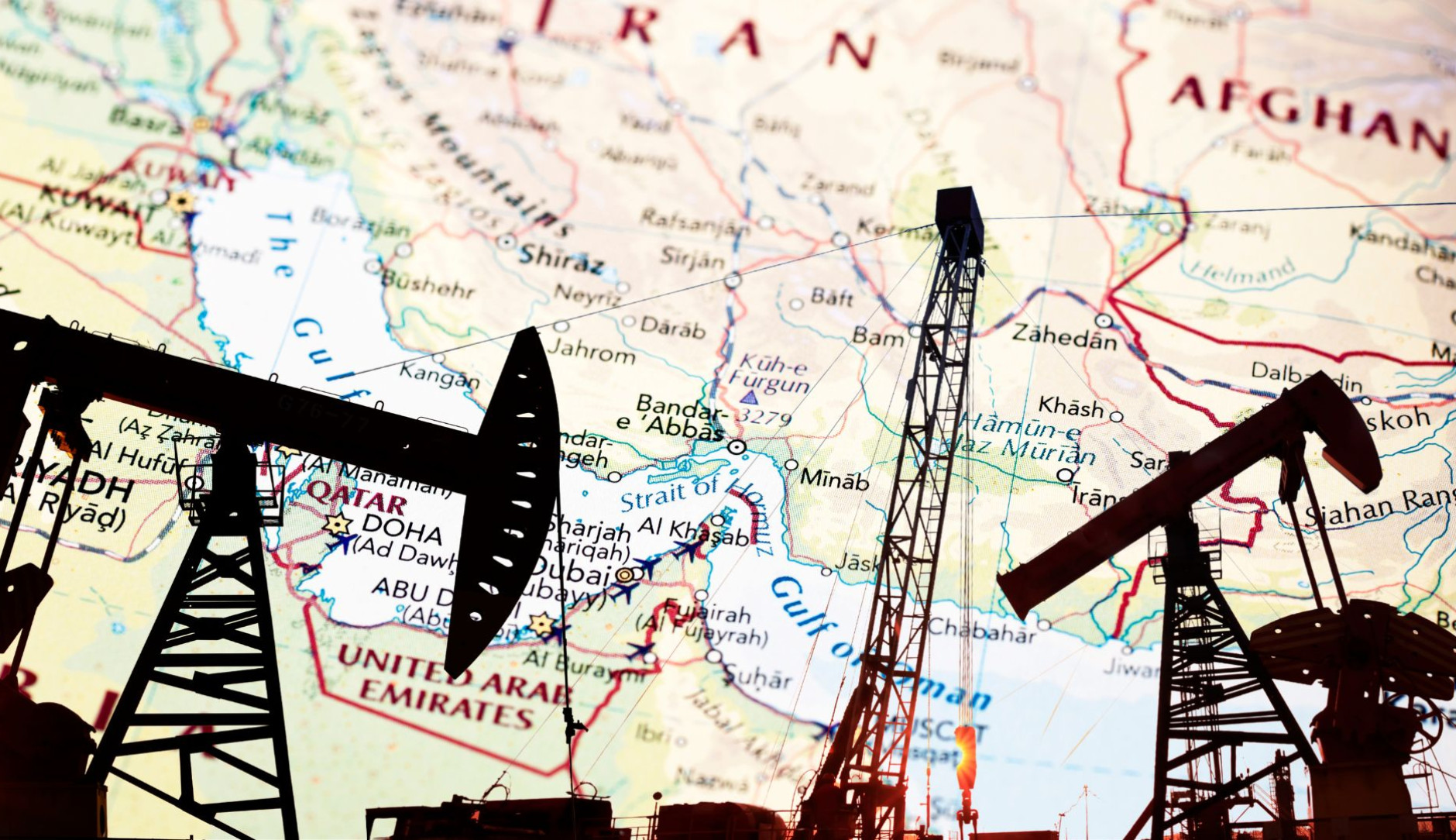
Once again, a war in the Middle East has sent fuel prices soaring, and once again, European governments, including Norway, have responded with fuel tax cuts and subsidies worth tens of billions of euros. We understand why. But after Ukraine, after Iran, after decades of fossil fuel dependency, Europe keeps treating the symptom instead of the disease. This time, the window for doing things differently is narrowing. Norway is not immune: DNV projects the country will become a net electricity impor
The Familiar Scene
It starts with a war. Oil markets react. Fuel prices spike. Across Europe, politicians respond within days: tax cuts, VAT reductions, price caps. Citizens get temporary relief. The crisis passes. And then everything goes back to normal, until the next one.
This is not cynicism. It is the documented pattern of European energy policy over the last decade.
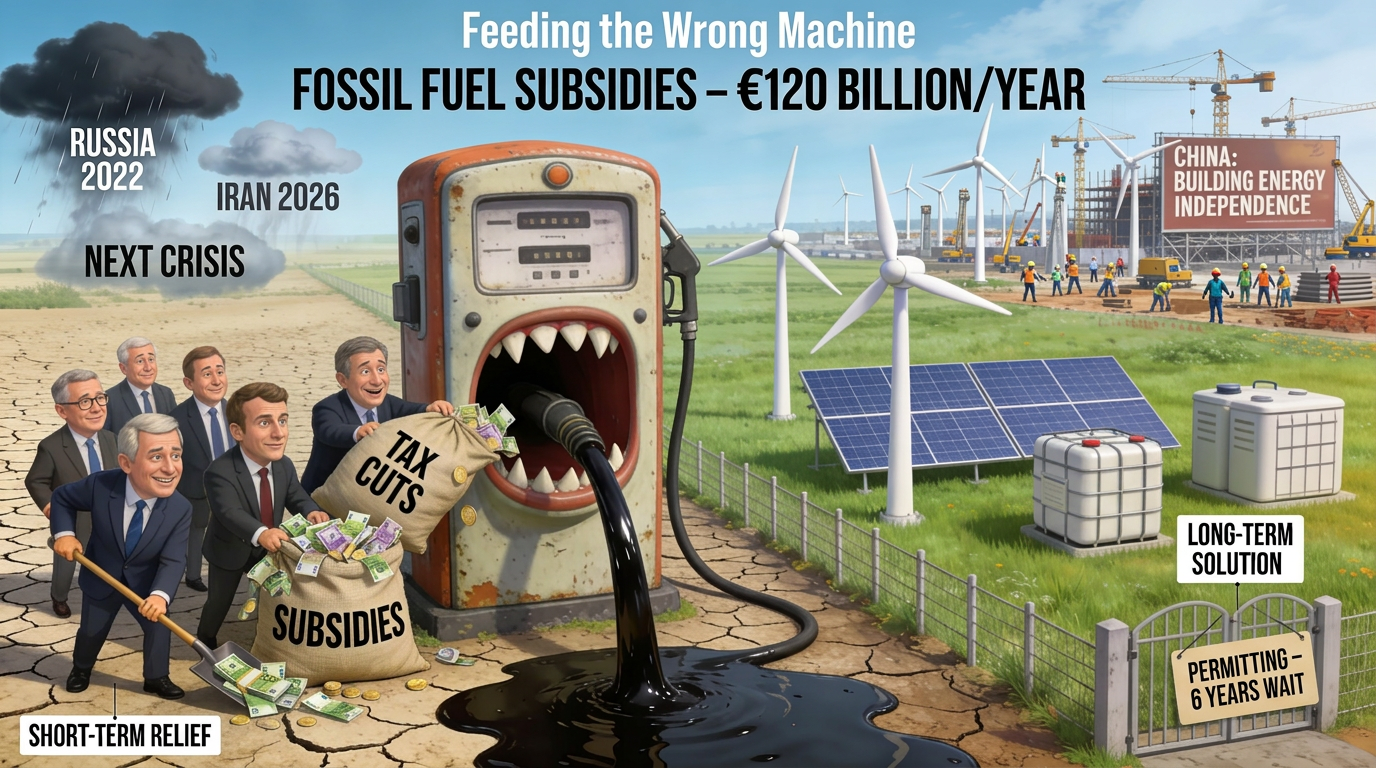
Last week, Norway's parliament approved a temporary cut to road fuel taxes, 4.41 NOK per liter on petrol and 2.85 NOK per liter on diesel, valid until September 2026, at a cost to the Norwegian state of 3.3 to 6.3 billion NOK in lost revenue. This comes from a country whose petroleum sector alone generated 656 billion NOK in state revenues in 2025, wealth accumulated from the very fossil fuels now disrupting global markets. Norway is not alone. Spain passed a €5 billion relief package including a VAT cut on fuels from 21% to 10%. Poland slashed fuel VAT from 23% to 8%. Across the EU, governments spent a combined €397 billion on energy subsidies at the peak of the Ukraine crisis in 2022. Even after prices eased, that figure stood at €120 billion in 2023, still nearly double what member states invest in renewables (€61 billion). Norway, despite its clean electricity base, is not an exception to this pattern: every petrol-pump subsidy delays the structural shift the country urgently needs.
Volt Norway does not oppose targeted, time-limited relief for households. People are facing real costs. Governments have a responsibility to respond. But relief without reform is not a policy, it is a habit. And Europe's habit of subsidising fossil fuels every time a crisis hits is making the underlying problem worse.
To understand why, we need to go back to where we have been before.
Déjà Vu: Russia, Then Iran
When Russia invaded Ukraine in 2022, European leaders spoke plainly about what the crisis exposed: decades of strategic naivety, a continent that had made itself dependent on a single authoritarian supplier for roughly half its gas needs, and a price to pay for that dependency measured in hundreds of billions of euros.
The response was bold in rhetoric. REPowerEU promised to end Russian dependency through accelerated renewables, new LNG terminals, and diversified supply chains. And in some respects it worked: Russian gas fell from roughly half of EU supply to a marginal share within two years. That was a genuine achievement, and Norway played a key role, dramatically ramping up gas exports to European markets to help fill the gap, reinforcing its position as Europe's most important energy partner.
REPowerEU is the European Commission's plan, launched in May 2022 in response to Russia's invasion of Ukraine, to rapidly reduce the EU's dependence on Russian fossil fuels by accelerating the rollout of renewable energy, improving energy efficiency, and diversifying energy supplies.
But the structural problem, dependency on imported fossil fuels from politically unstable regions, was not solved. It was shuffled. Europe replaced Russian pipeline gas with US and Qatari LNG, Middle Eastern oil, and continued indirect Russian imports via third-country routes. The supplier changed. The vulnerability did not. And Norway's ability to plug every future gap with gas exports is not unlimited, not least because Norway's own energy future looks very different from what it does today.
Now the Iran war has disrupted another major corridor. Prices have spiked again. And the response across almost every European government is the same playbook as 2022: absorb the shock, help consumers, and move on.
This is the cycle. And the reason it keeps repeating is that we never fully invest in breaking it. Each crisis generates subsidies instead of structural change. Each round of subsidies delays the investments that would make the next crisis irrelevant. The trap is self-reinforcing, unless we consciously decide to exit it.
Norway Is Not As Safe As It Looks
Before examining what Europe as a whole must do, it is worth pausing on Norway's specific position, because Norway is often held up as an energy success story, and in many ways it is. Nearly 90% of electricity comes from hydropower. The EV transition has been extraordinary: Norway now leads the world with 87% of new car sales being electric. Norwegian households are, on average, far better positioned for an electrified future than most of their European neighbours.
But this picture is misleading as a guide to what comes next.
According to DNV's Energy Transition Outlook Norway 2025, electricity demand will grow by 18 TWh over the next five years, the equivalent of one million households, while new power development will deliver only 3 TWh in the same period. Demand is currently growing six times faster than supply. The reason is straightforward: EVs, industrial electrification, oil and gas platform conversion, and a rapid expansion of data centres are all pulling simultaneously on a grid that is not being expanded fast enough to keep up.
The consequence is that Norway is on track to become a net electricity importer by the early 2030s, with a projected annual import deficit of up to 5 TWh by 2033. This spring has already provided a preview: low snow levels have depleted reservoirs, and Norway has faced electricity shortages in early April 2026, an almost unthinkable situation for a country that has long exported clean power to Europe.
If Norway becomes a net importer, it will be buying electricity at European market prices, prices that are set in part by the same geopolitical disruptions it currently avoids. The insulation that hydro provides is real, but it is conditional on maintaining a surplus. That surplus is disappearing.
The solution is known. DNV's modelling shows that if onshore and offshore wind are developed at scale, alongside grid upgrades and cross-border interconnection, Norway can return to a comfortable surplus and resume its role as a major clean energy exporter to Europe. But the window for that investment is now. Permitting delays, local opposition, and political hesitation on offshore wind have already cost years. More delay means Norway will live through the energy import dependency it has spent a generation avoiding.
So when Norway's parliament cuts fuel taxes this week without any accompanying commitment to accelerate that investment, it is not just missing a chance to get ahead of a European problem. It is deferring the solution to a Norwegian one.
The Trap We Are Building for Our Own Citizens
The short-term logic of fuel subsidies is understandable. But it sits in direct contradiction with policies already on the books, and that contradiction is creating a quiet trap for the very consumers governments are claiming to protect.
Carbon pricing under the EU's ETS2 scheme , which covers road transport and heating from 2028, is projected to push allowance prices to between €71 and €126 per tonne CO₂ by 2030, with some scenarios reaching €261/tonne. In practical terms, this means approximately €0.20–0.50 extra per liter of petrol and an additional €50–200 per household per year in heating costs, phasing in over the coming years.
ETS2 is the EU's second Emissions Trading System, adopted under the European Green Deal. Unlike the original EU ETS — which targets heavy industry and power generation — ETS2 covers the road transport and buildings (heating) sectors, set to begin in 2027. Carbon costs are passed through to fuel suppliers and heating fuel distributors, and are expected to significantly raise the price of petrol, diesel, and heating fuels for end consumers.
This is not a proposal. ETS2 is law.
Norway, as an EEA member, participates fully in the existing EU ETS, and has stacked its own national carbon tax on top of it, one of the most ambitious in the world, targeting 2,000 NOK per tonne CO₂ (~$190/tonne) by 2030. Norwegian aviation, shipping, heavy transport, and industry are all directly exposed to these rising costs. This means Norwegian airlines, ferry operators, freight companies, and manufacturers will face some of the steepest carbon cost increases in the world over the coming years, costs that will flow through to ticket prices, freight rates, and consumer goods. ETS2, when it arrives, will add pressure on road transport and heating on top of all of this.
The EU Emissions Trading System (EU ETS) is a "cap-and-trade" carbon market covering large industrial emitters, power plants, and aviation within the EU and EEA. It sets a cap on total greenhouse gas emissions and requires companies to hold allowances for each tonne of CO₂ they emit. Norway has participated in the EU ETS since 2008 as part of the European Economic Area (EEA).
For Norwegian businesses and households, this is not a distant Brussels problem. It is a domestic cost trajectory that is already locked in. Governments that cut fuel taxes now while failing to give consumers viable alternatives are not helping people prepare, they are leaving them exposed.
Now consider what European governments are signalling to their citizens in parallel: fuel is temporarily cheaper, so keep driving. Gas boilers are still the norm, so stick with what you know. No urgent reason to switch yet.
Consumers who buy a new petrol car in 2026 will still be driving it in 2032, when ETS2 is biting. Households that delay heat pump installation will still be on gas in 2030. These are not abstract scenarios, they are the predictable outcome of policies that cut fossil costs today while leaving the carbon pricing trajectory unchanged. In Norway, where both ETS and national carbon taxes apply simultaneously, the cost escalation will be steeper and faster than almost anywhere else in Europe.
The result is a political crisis in slow motion. In five to ten years, carbon prices will make fossil fuels noticeably more expensive. Millions of households will face rising costs with limited alternatives. And the temptation, already visible in early ETS2 debates, where member states have pushed for lower price caps and delayed timelines, will be to water down the carbon pricing mechanism that was supposed to drive the transition.
If we are not careful, short-term relief today becomes the justification for long-term climate backsliding tomorrow. And the people who will pay the price are ordinary consumers, Norwegian and European alike, who were never told the full picture.
The Investment We Are Not Making
The money to fund a real transition is not hypothetical. It is already being spent, just on the wrong things.
In 2023 alone, EU member states spent €120 billion on fossil fuel subsidies. Norway's own fuel tax relief this spring will cost the state an estimated 3.3 to 6.3 billion NOK in lost revenue, money that could have seeded offshore wind development, grid upgrades, or heat pump programmes. Compare this with what genuine transition investment would look like:energy.
The EU's flagship REPowerEU response to the Ukraine energy crisis was budgeted at €300 billion over several years, roughly 2.5 years of current EU fossil subsidies.
The EU's ETS2 carbon market is projected to generate €705 billion between 2027 and 2035, revenue that could directly fund heat pump rebates, EV transition support, grid upgrades, and building retrofits.
Research shows that redirecting as little as 10% of annual global fossil fuel subsidies could dramatically accelerate clean energy deployment worldwide.
For Norway specifically, DNV identifies onshore and offshore wind as the only commercially mature, scalable options to close the looming supply gap in time. These require investment decisions now to deliver capacity before the deficit arrives.
Every euro, or krone, spent subsidising petrol this week is money not spent insulating a Norwegian home, connecting an offshore wind farm to the grid, or building the cross-border electricity infrastructure that would carry clean Norwegian power to Germany and Poland. These are not competing goods. They are the same budget, made under political pressures that consistently favour the visible short-term fix over the invisible long-term investment.
The European Environment Agency has repeatedly called for phasing out fossil fuel subsidies and redirecting them to clean energy and efficiency. The Commission's own energy subsidies report acknowledges progress is too slow. The will exists at the technical level. What is lacking is the political decision to make it binding, in Oslo as much as in Brussels or Berlin.
While Europe debates whether it can afford to invest more in renewables, one country has already answered that question decisively, and it is not in Europe. In 2024, China invested $625 billion in clean energy, accounting for nearly a third of all global transition investment and more than double any other economy. In that same year, it installed 360 GW of new wind and solar capacity, more than the rest of the world combined, bringing total installed wind and solar to 1.4 TW. In 2025, it added another 430 GW, pushing renewable energy past 60% of total installed power capacity for the first time. Electricity generated from Chinese renewables in 2025 alone exceeded the combined power consumption of all 27 EU member states. China is not doing this out of environmental idealism. It is doing it to achieve exactly what Europe keeps promising and failing to deliver: energy independence, industrial cost competitiveness, and insulation from geopolitical supply shocks. Clean energy already drove more than a third of China's entire GDP growth in 2025. While European governments cut fuel taxes to manage this month's crisis, China is building the infrastructure that means it will not need to care about the next one. Norway's petroleum revenues, and the EU's fossil subsidy budgets, could be funding the same kind of structural advantage, if the political will existed to redirect them.
The Transition Is the Affordable Option
There is a case for the energy transition that has nothing to do with climate and everything to do with economic rationality. It is the case that Europe's industries, households, and governments are currently losing the argument on, and it is the most important one to win.
Fossil fuels are, structurally, a price-volatile product set by global markets far outside European, or Norwegian, control. Every disruption, whether a Russian invasion, an Iranian war, a Houthi blockade, or a Saudi production cut, passes directly through to European household bills and industrial energy costs. This volatility is not incidental. It is inherent. You cannot fix it by diversifying suppliers, because the suppliers are still selling a commodity priced on global markets.
Renewables do not work this way. Once a wind farm or solar array is built, its fuel is free. The marginal cost of production is essentially zero. The price of Norwegian wind electricity is not affected by a war in the Persian Gulf. German solar does not get more expensive because Qatar decides to redirect an LNG shipment. Norway already knows this from its hydro base: when reservoirs are full and the grid is strong, Norwegian electricity is among the cheapest in Europe. The goal is to replicate that logic at scale, with wind complementing hydro and feeding both domestic demand and European export markets.
This means that a Europe with a high share of renewables, strong interconnected grids, and sufficient storage is structurally insulated from the kind of price spikes that are, right now, prompting billions in emergency subsidies. The investment cost is front-loaded. The operating cost is low and stable. And studies consistently show that a fully electrified system based on renewables results in lower long-term consumer prices than one reliant on imported fossil fuels.
Renewables already account for over 70% of EU electricity generation. Norway's hydro base means it is already further along than most. The trajectory is clear and the technology is mature. What is slowing progress is not engineering, it is political prioritisation. Germany's wind projects face average approval timelines of six years or more. Norway's offshore wind remains largely stuck at the planning stage. Permitting systems designed for a different era are acting as the main brake on a transition the market would otherwise accelerate.
Meanwhile, Germany is planning to tender 12 GW of new gas-fired power capacity in 2026, with hydrogen compatibility cited as a future justification. These plants will operate for 25–30 years. They will require fuel imports throughout their operational lives. They will generate stranded asset risk as carbon prices rise and clean alternatives become cheaper. Norway faces a similar temptation: to lean on existing gas infrastructure and deferred decisions rather than making the harder but correct investment call now. That path leads back to the same cycle, only with Norway on the wrong side of it.
The economics of new fossil capacity, measured honestly over a full asset lifetime and against carbon pricing trajectories, do not stack up. They are being chosen for political reasons, to signal "reliability" in a crisis moment, not because they are the rational long-term choice.
What We Are Asking For
The argument above leads to a clear set of demands. They are not utopian. They are, in most cases, policy options already proposed at EU level, and in many cases relevant at Norwegian national level, that lack only the political will to implement them at the necessary speed and scale.
1. Connect every crisis subsidy to a transition commitment.
Short-term relief for households is legitimate. But it should not come without a matching investment in the alternatives that make the next crisis irrelevant. Norway's fuel tax cuts should be paired with expanded offshore wind investment, grid upgrade funding, or heat pump subsidy programmes. Relief alone is spending. Relief plus investment is policy.
2. Norway must treat its energy supply gap as a national priority.
The DNV projections are not a distant scenario. They are a near-term planning reality. Permitting for onshore wind and offshore wind must be accelerated. Grid expansion must be funded. Norway's role as a clean energy exporter to Europe, valuable geopolitically and economically, depends on building surplus capacity now, before the deficit arrives.
3. Redirect fossil fuel subsidies to the transition, at EU and national level.
€120 billion per year in EU fossil subsidies, plus billions more in national-level relief programmes like Norway's, is not a fixed cost of modern life. It is a political choice. Member states must agree a binding phase-out timeline, aligned with ETS2 implementation, and redirect those revenues to transition programmes. Norway should lead by example here, given its carbon tax ambitions and its stated climate commitments.energy.europa+1
4. Reform permitting across Europe, and in Norway, as a matter of urgency.
Wind projects that take six years to permit are not delayed by physics or engineering. They are delayed by regulatory systems that were not designed for the climate challenge we face. EU-wide fast-track permitting for renewable energy and grid infrastructure, with binding national implementation timelines, must be a central plank of EU energy policy. In Norway, where offshore wind consenting has moved at a glacial pace, this reform is not optional, it is existential for the country's energy balance.
5. Stop approving new long-term fossil infrastructure.
New gas power plants, new LNG terminals, new fossil capacity of any kind locks in import dependency for decades. Investment in infrastructure that will face rising carbon costs, market displacement by cheaper renewables, and potential stranded asset write-offs is a poor use of public and private capital. The climate case is also the financial case, and for Norwegian industry facing some of Europe's steepest carbon costs, the risk of investing in fossil-dependent operations is a direct business risk.
6. Build a genuine European energy solidarity framework, with Norway as a full partner.
Norway is not an EU member, but through the EEA it is already part of the internal energy market, participates in EU ETS, and is deeply integrated into European energy flows. Fragmented national responses, Norway cutting fuel taxes here, Spain subsidising VAT there, Poland protecting coal elsewhere, produce collective failure at the European level. A coordinated EU energy sovereignty strategy, with shared investment in cross-border grids, joint strategic reserves, and binding renewable capacity commitments, must include Norway as a central contributor. The interconnectors that carry Norwegian hydro to Germany and Denmark are strategic European infrastructure. They need to be treated as such.
One Pattern, One Choice
Everything in this article comes back to a single pattern: crisis hits, subsidies flow, structural change is deferred, the next crisis arrives. We have been through this with Russia. We are going through it again with Iran. The question is not whether we can afford to invest in the transition. It is whether we can afford not to.
The cost of inaction is not just climate damage, though that cost is real and accelerating. It is the economic cost of continued price volatility passed to Norwegian and European households. It is the security cost of remaining dependent on supply chains that run through war zones. It is the industrial cost of European companies, including Norwegian ones facing ETS and national carbon taxes simultaneously, paying more for energy than their US and Chinese competitors. And it is the political cost of governments that, in a decade, will face angry voters trapped in fossil fuel dependency they were never helped to escape.
Norway has a unique opportunity and a unique responsibility here. Its hydro base is a foundation no other country can match. Its EV transition is a model the world is watching. Its potential as a clean energy exporter to Europe, via offshore wind and expanded interconnectors, is substantial. And its direct participation in EU carbon markets means it cannot treat European climate policy as someone else's agenda. ETS costs fall on Norwegian airlines and freight companies today. ETS2 will reach Norwegian households and drivers tomorrow.
But none of that potential is self-executing. It requires investment decisions made now, political courage to accelerate permitting and prioritise the grid, and a willingness to treat the looming supply deficit not as a future problem but as a present one.
Volt Norway will keep pushing for that, here at home and across Europe. Because energy sovereignty is not a technical challenge. It is a political one. And political choices are exactly what we are here to contest.
Volt Norway is part of Volt Europa, a pan-European political party advocating for federal European solutions to cross-border challenges. Figures cited are drawn from DNV Energy Transition Outlook Norway 2025, European Environment Agency, EU Commission energy subsidy reports, Bloomberg NEF, and Reuters.
Sources available on request.